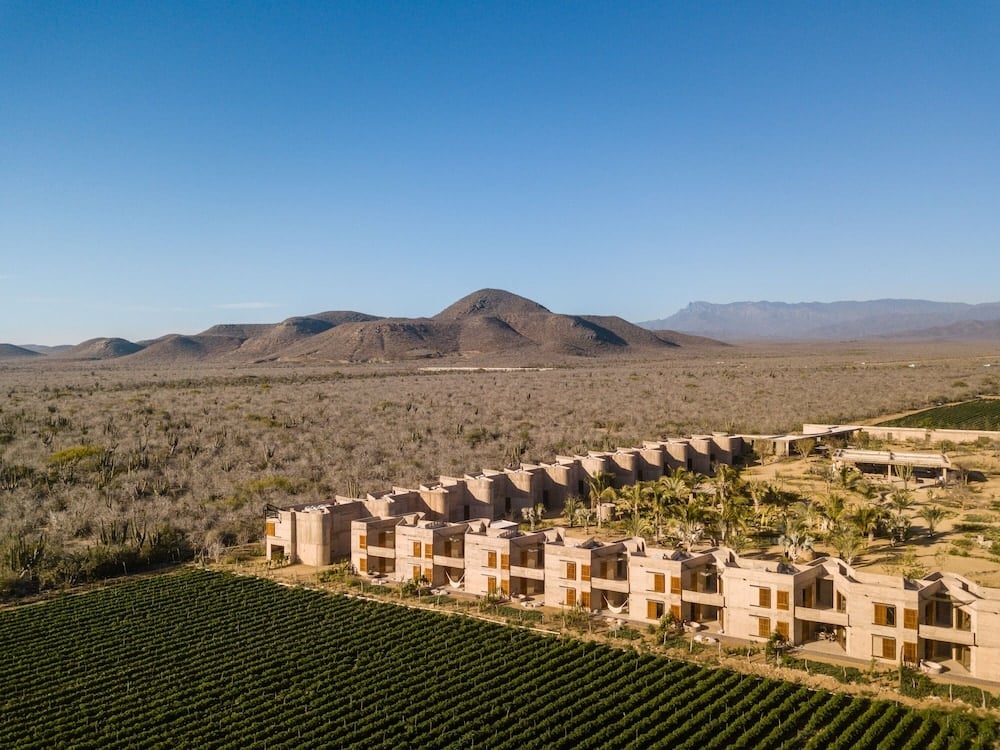
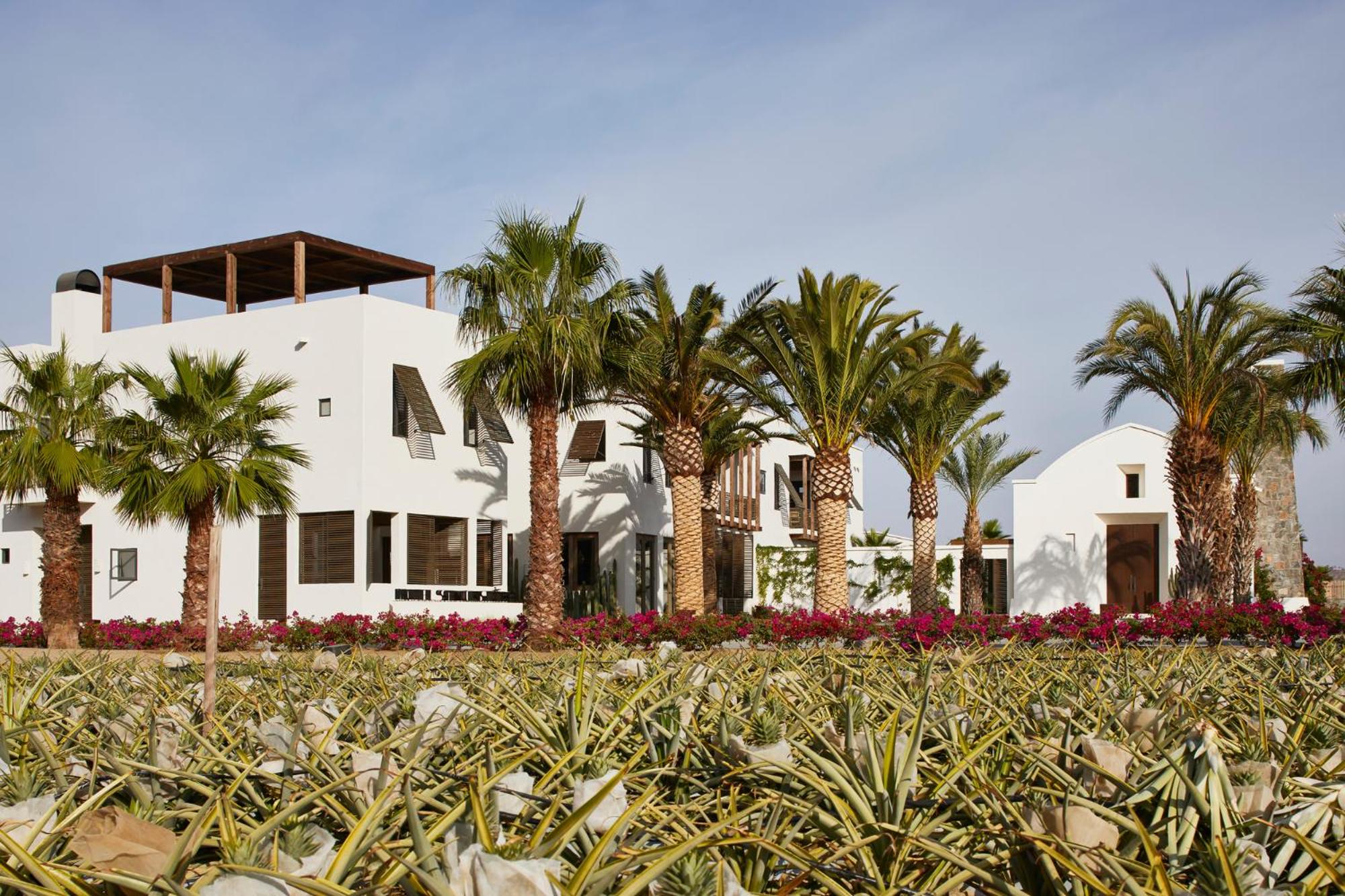
The road south from La Paz narrows, the scrubland thickens, and the light shifts to something warmer, more golden, more insistent. Then the landscape opens and Paradero Todos Santos appears, not as a building imposed upon the desert but as something that seems to have risen from it. Concrete, rammed earth, and local stone form low-slung volumes that sit quietly against the arid terrain, their geometries softened by native plantings and the weathering hand of sun and salt air. The architecture draws equally from Brutalist restraint and the organic textures of the Baja peninsula, creating spaces that feel monumental in proportion yet deeply intimate in practice.
The property's 35 suites are designed around the concept of indoor-outdoor living pushed to its fullest expression. Sliding walls dissolve the boundary between sleeping quarters and private terraces, while outdoor soaking tubs, fire pits, and shaded daybeds extend each room into the landscape. Some suites open to the desert, others orient toward the Pacific, and the most expansive feature rooftop decks where the sky becomes the dominant architectural element. Materials remain honest throughout: polished concrete floors, linen bedding, handcrafted ceramics, and wood that has been left to age naturally. The effect is pared back without austerity, a place where texture and light do the work that decoration typically attempts.
Daily life at Paradero Todos Santos moves between water, earth, and table. The main pool stretches across a sun-drenched terrace, flanked by loungers and shaded cabanas that look out toward the surrounding hills. A purpose-built surf club connects guests to the Pacific breaks nearby, with boards, guides, and post-session recovery woven into the offering. The spa draws on the region's botanical traditions, incorporating locally sourced herbs and minerals into treatments administered in open-air treatment rooms where the desert breeze serves as a kind of co-therapist. For those drawn to the land itself, guided hikes, horseback rides through the sierra, and farm visits round out the programming. The on-site restaurant centers its menu on ingredients pulled from the property's own organic garden and the surrounding farms of the Todos Santos agricultural corridor, presenting Baja cuisine that is vibrant, produce-forward, and deeply tied to place. Mezcal and natural wines anchor the bar program, served in spaces where firelight takes over as the sun drops.
Todos Santos itself is a town of contradictions held in easy balance: a designated Pueblo Mágico with a thriving arts scene, dusty colonial streets lined with galleries, and a Pacific coastline that remains largely undeveloped. The Sierra de la Laguna mountains rise to the east, the ocean stretches west, and the town sits at the intersection of desert ecology and subtropical abundance, a microclimate that has drawn artists, surfers, and farmers for generations. Paradero channels this convergence into something coherent and deeply felt. It is not a resort that happens to be in the desert. It is a place shaped by the desert, by the ocean wind that crosses it each afternoon, by the quality of morning light on raw concrete, and by the particular silence that settles over the Baja lowlands at dusk.