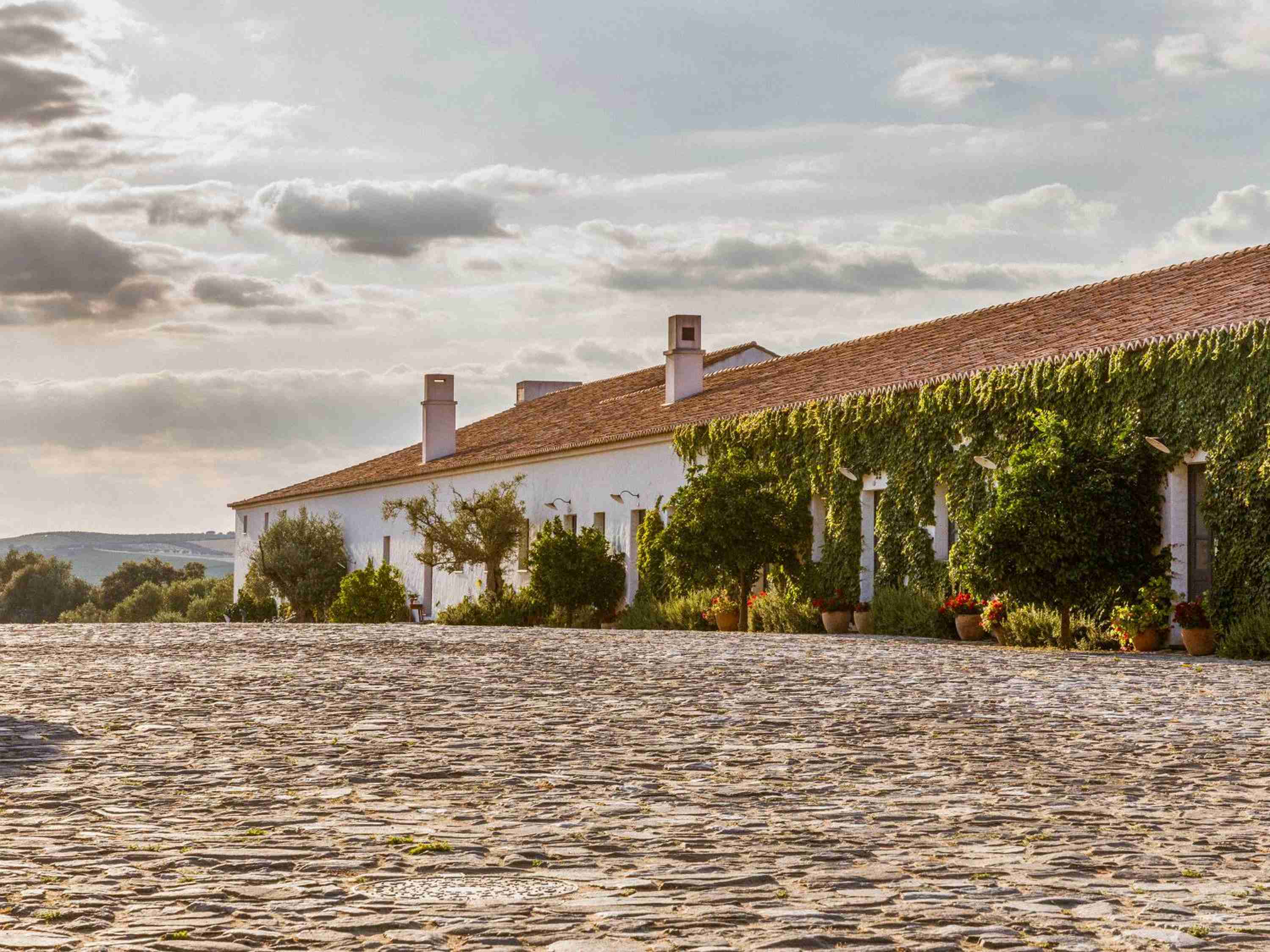
The approach alone tells you something essential. A long road through open Alentejo plain gives way to ancient olive groves, cork oaks, and granite boulders scattered across low hills as if placed by some earlier hand. Then the cluster of whitewashed buildings appears, low and luminous against the landscape, and you understand that São Lourenço do Barrocal is not a hotel built to resemble a country estate. It is a country estate, one that has been farmed continuously for over eight hundred years, now reimagined as a place where agricultural heritage and contemporary design coexist without friction. The property spans nearly two thousand acres of working farmland, and every corner of the architecture carries the weight of that lineage. Thick stone walls, lime-washed surfaces, hand-hewn timber, and iron details have been restored with care by architect Eduardo Souto de Moura, whose intervention reads as preservation rather than reinvention. The result is a property that feels ancient and alive at once.
Accommodations are spread across forty rooms and suites housed within the estate's original farm buildings, along with a handful of independent cottages set among the grounds. Interiors are spare, warm, and grounded in natural materials: local marble, terracotta, linen, and wood. Furnishings mix Portuguese antiques with clean-lined contemporary pieces, and the scale of the rooms feels generous without excess. Many open onto private gardens or terraces that look out across the property's vineyards and olive groves. The cottages offer greater seclusion and space, suited to longer stays or families seeking room to spread out.
The estate's restaurant draws from what the land itself provides, with menus shaped by the organic garden, the olive press, and the property's own wine production. Meals are served in a stone-walled dining room or outdoors beneath the trees, and the cooking reflects the Alentejo's tradition of honest, ingredient-led simplicity. Wine from the estate's vineyards accompanies nearly everything. Elsewhere on property, a swimming pool stretches long and still amid the landscape, its stone surround blending into the terrain. A wellness space offers treatments rooted in local botanicals and the estate's own herbs. Horseback riding through the surrounding countryside, guided walks among the megalithic stones that dot the property, cycling through the cork forests, and wine tastings at the estate's own adega round out a pace of life that is active but never hurried.
The Alentejo is Portugal's great interior, a region of vast horizons, sparse population, and deep agricultural tradition. The landscape surrounding the estate is marked by rolling plains, wildflower meadows in spring, and a quality of light that shifts from gold to amber across the day. Nearby, the medieval town of Monsaraz sits on a hilltop ridge above the Alqueva reservoir, its narrow streets and castle walls offering one of the most striking silhouettes in southern Portugal.
What lingers most about São Lourenço do Barrocal is the coherence of it all. The wine you drink at dinner comes from the vineyard you walked through that morning. The olive oil was pressed on site. The stone beneath your feet has been here for centuries. It is a property where luxury is not layered on but grown from the ground, and where the rhythm of the day follows the rhythm of the land.