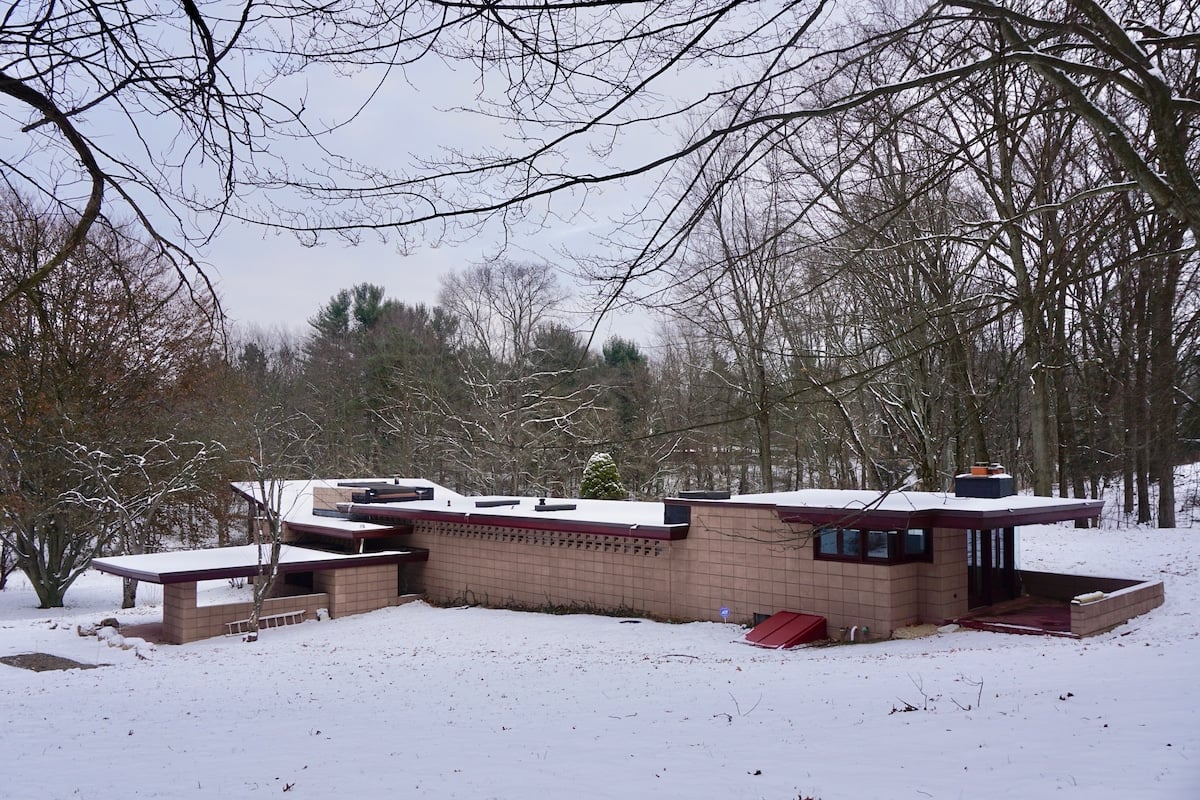
The roofline arrives first. Low, cantilevered, and stretching outward as if the house itself is reaching toward the landscape, Frank Lloyd Wright's Eppstein House announces its pedigree before you ever step inside. Built in 1948, this is an authentic Usonian home, one of Wright's mid-century designs intended to reimagine the American residence as something organic, democratic, and deeply connected to its site. The angles are deliberate. The materials are honest. Every window frames nature as though it were hung on the wall. Staying here is not a novelty or a museum visit. It is a chance to live, briefly, inside the mind of America's most consequential architect.
The home's open floor plan unfolds with Wright's characteristic spatial intelligence, where compression and release guide you from intimate corridors into expansive living areas flooded with natural light. Original Cherokee red concrete floors carry warmth underfoot, while the signature Wright woodwork and built-in furnishings remain intact, each element designed not as decoration but as architecture. The bedroom, kitchen, and living spaces maintain the proportions Wright intended, creating a sense of shelter that never feels confining. You sleep in a space where every joint, every overhang, every material choice was made by one hand, with one vision. The home accommodates guests who appreciate that kind of integrity, offering a complete residential experience with a fully equipped kitchen and the quiet privacy of a single-family home.
What makes the Eppstein House remarkable beyond its provenance is how livable it remains. This is not a roped-off landmark. You cook in the kitchen, read in the living room, wake to the geometry of Wright's windows filtering morning light in patterns he calculated decades ago. The surrounding grounds reinforce the Usonian philosophy of dissolving boundaries between interior and exterior, with the landscaping and approach designed to feel continuous with the architecture. Time here moves at a pace the house seems to insist upon, slower and more considered, shaped by the rhythm of natural light shifting across concrete and wood.
To stay in the Eppstein House is to understand something about Wright's work that photographs and monographs cannot convey. It is the way sound travels through these rooms, the way the ceiling height changes your posture, the way a wall of glass makes a backyard feel infinite. You leave with the quiet recognition that architecture, at its finest, is not something you look at. It is something that changes the way you move, breathe, and rest.