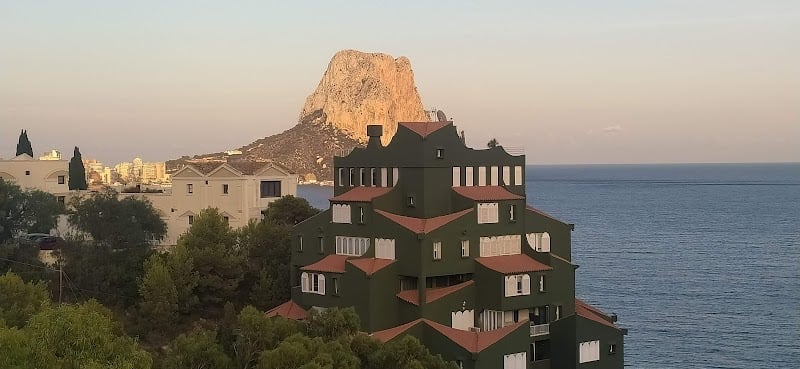
The first thing you notice is the color. Walls in shades of terra-cotta, violet, indigo, and pale pink rise in stacked geometric volumes, forming a labyrinth of staircases, bridges, and hidden courtyards that seem to belong more to a surrealist painting than to the built world. The Red Wall, known in its original Spanish as La Muralla Roja, is Ricardo Bofill's iconic postmodern residential complex, a striking architectural statement that has drawn admirers and pilgrims since its completion in 1973. To stay here is to inhabit a living work of art, one where every corridor opens onto an unexpected angle, every rooftop terrace frames the Mediterranean in a new composition, and the interplay of light and shadow shifts the entire palette hour by hour.
The building's design draws on the tradition of the North African casbah, with its interlocking towers, narrow passageways, and communal spaces that blur the line between interior and exterior. Apartments are arranged within the complex's interconnected volumes, offering private residences that open onto shared patios and walkways. The spaces are deliberately intimate, favoring clean lines and purposeful geometry over ornament. Rooftop areas provide open-air platforms for sunbathing and quiet contemplation, with unobstructed views across the sea. A cross-shaped swimming pool set within the building's upper levels has become one of the most photographed architectural details on the Mediterranean coast, its turquoise water reflecting the surrounding walls in vivid contrast. The experience of moving through The Red Wall is inherently spatial. You navigate staircases that seem to lead nowhere and everywhere at once, discovering small terraces tucked between walls of opposing color, or suddenly emerging onto a sun-drenched platform where the horizon stretches wide and uninterrupted.
The surrounding coastline provides a natural counterpoint to the building's bold geometry. Rocky coves and clear water lie just below, offering a landscape that is dry, rugged, and distinctly Mediterranean. The area's climate invites long days spent between sea and sky, and the building's orientation ensures that residents are always within a few steps of both open air and sheltered shade. This is not a traditional hotel with lobbies, concierges, and programmed itineraries. It is an architectural residence, a place where the structure itself is the experience, and where your days are shaped by the slow movement of light across colored surfaces.
What lingers after time spent at The Red Wall is a kind of spatial memory. You recall the way a staircase turned and suddenly revealed a rectangle of deep blue sky framed by rose-tinted concrete. You remember the silence of an interior courtyard at midday, the warmth of a wall against your hand, the geometry of shadows pooling at your feet. It is a place that asks very little of you except attention, and in return offers something that few buildings in the world can: the sensation of living inside color itself.