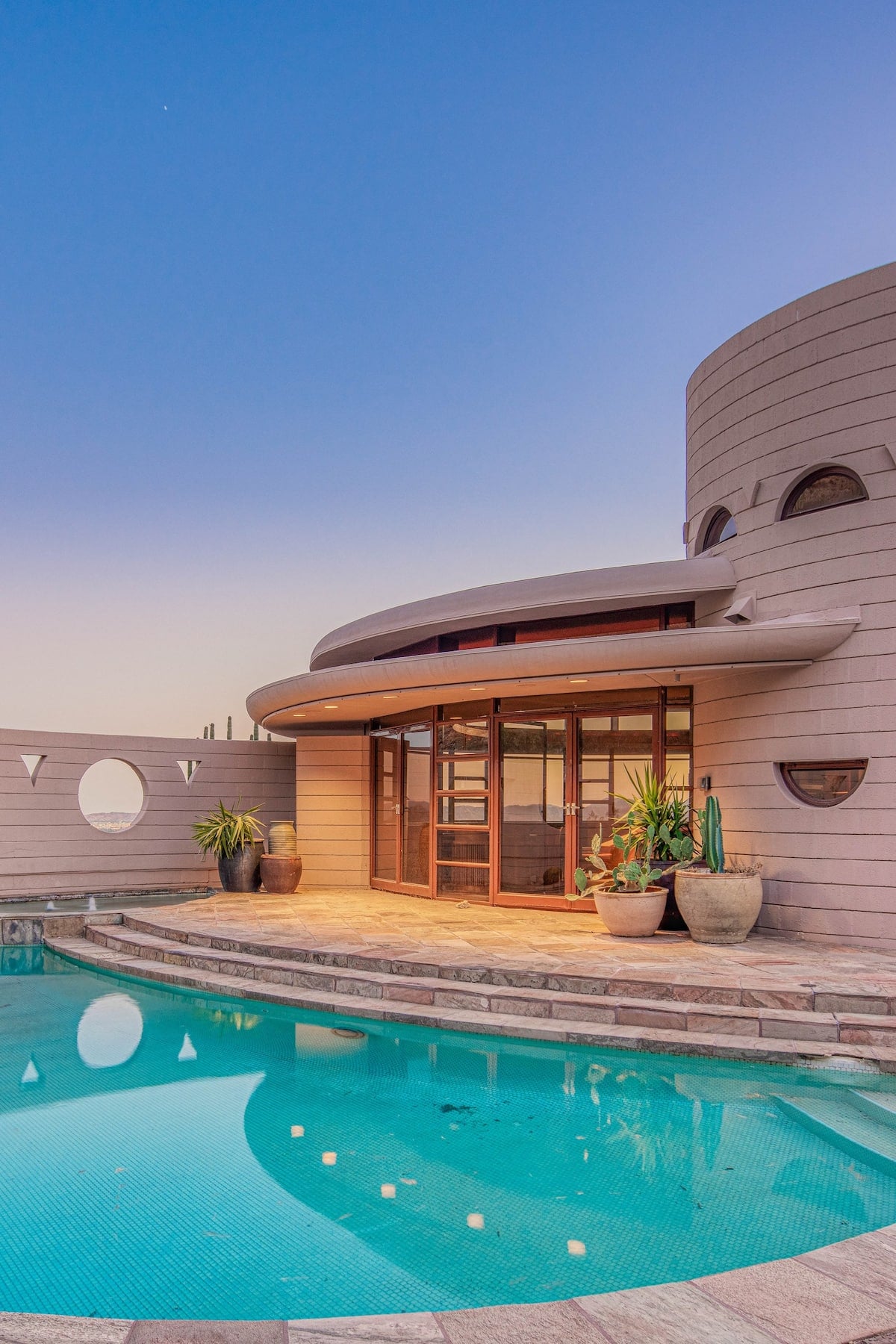
The Norman Lykes House is a residence unlike any other. Designed by Frank Lloyd Wright in 1959 and completed after his death by his apprentice John Rattenbury, it stands as the last residential commission of the most influential architect in American history. Set into the rugged slopes of Palm Canyon in Phoenix, Arizona, the home is a study in circular geometry, its curving walls and cantilevered forms reaching outward as if shaped by the desert wind itself. From the moment you arrive, the architecture commands your attention, not through spectacle, but through an almost gravitational sense of belonging to the landscape.
The house unfolds in a continuous circular plan, where walls curve seamlessly into ceilings and windows wrap around living spaces to frame panoramic views of the Sonoran Desert. Concrete block, glass, and Philippine mahogany compose the material palette, each element chosen with Wright's characteristic insistence on harmony between structure and site. The main living areas flow without interruption, from the sunken living room with its built-in seating and original Wright-designed furnishings to the cantilevered terrace that extends the interior outward into open air. Throughout, the interplay of light and shadow shifts constantly, the desert sun animating the home's geometry in ways that feel less designed than discovered. The residence includes three bedrooms and three bathrooms, with the primary suite positioned to capture sweeping mountain and city views. Many of the original furnishings and built-in elements remain intact, offering an experience that is closer to inhabiting a work of art than simply staying in a house.
The surrounding landscape is as essential to the experience as the architecture. The property sits on over a thousand feet of elevation in the foothills, with native desert vegetation and exposed rock forming the immediate environment. Phoenix's cultural offerings, from the Desert Botanical Garden to Taliesin West, Wright's own desert laboratory and school, are within reach. But the Norman Lykes House has a way of making the outside world feel distant. The home's orientation, its careful framing of sky and mountain, creates a sense of enclosure and openness simultaneously, a quality Wright pursued throughout his career and perfected here in its final expression.
To stay in this house is to experience the closing chapter of a singular creative mind. There is no lobby, no concierge desk, no restaurant downstairs. What exists instead is an architectural testament, a place where every curve and cantilever was drawn with purpose, where the desert light enters on Wright's terms. The Norman Lykes House does not perform luxury. It offers something rarer: the chance to live, even briefly, inside a vision that took a lifetime to refine.